

Site & Workshop Saws
Site and workshop saws are the heavy, semi-portable sawing tools that live either in the joinery workshop or on the fixed timber-cutting station on site: table saws with folding leg stands for site work, flip-over saws that convert between bench and mitre modes, industrial radial arm saws for continuous cross-cutting production, and precision scroll saws for detailed curve work and craft joinery. This is the collection for joinery workshops, bench joiners, site carpenters, furniture makers, trim carpenters, cabinet shops and craft workshops that need proper trade sawing capacity beyond what a handheld circular saw or mitre saw can deliver.
You will find site saws with folding leg stands for portable timber cutting on construction sites, flip-over saws that combine table saw and mitre saw functions in one machine, radial arm saws for high-volume cross-cutting in joinery production, and scroll saws for fine detail curve cutting in model work, marquetry and cabinet joinery. Key features across the range: blade capacities from 250mm and 315mm site saw sizes up to 350mm industrial radial arm, motor power from 120W scroll saw precision motors up to 4000W 3-phase industrial motors, 110V site transformer versions for UK construction sites plus 240V mains for workshop use, and industrial 3-phase options for permanent joinery installations.
The brands here are the ones UK joinery workshops trust: DEWALT (with the DW743N Flip-Over and DW729KN Radial Arm industrial ranges), Makita (with the 2712/2 site saw available in both 110V site and 240V workshop variants), Metabo (with the TKHS 315 M professional site saw) and Einhell (with the TC-SS 406 E scroll saw for detail and craft work).

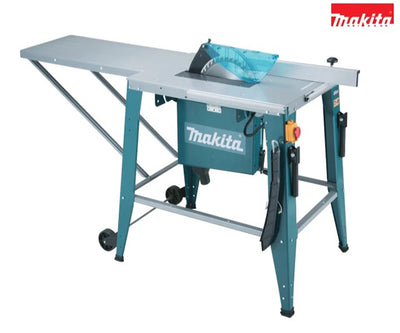
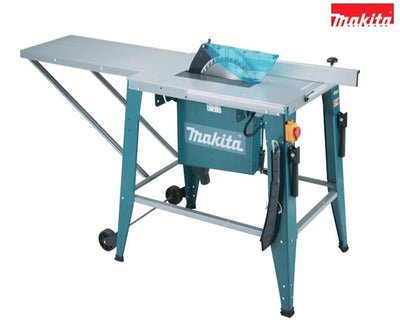
Site saws, workshop saws and radial arm saws at MTN Shop UK
Site and workshop saws are the machines that separate a trade joinery operation from a bag of handheld power tools. When you are ripping full 8x4 sheets to size, cross-cutting a stack of studwork identically for a partition wall run, or working through joinery components that need repeatable precision cuts, you need a proper table saw or radial arm saw rather than a handheld circular saw and a straight edge. The Site and Workshop Saws collection at MTN Shop UK covers the four main categories in this segment: site saws, flip-over saws, radial arm saws and scroll saws, each with a different specialist purpose in a professional joinery or site operation.
Site saws: portable table saws for construction
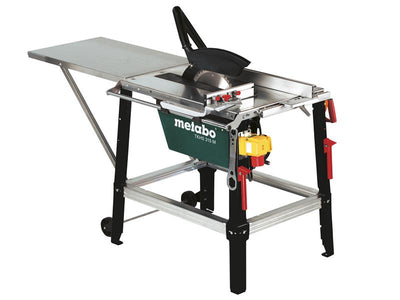
A site saw is a table saw designed for construction site use: robust folding leg stand for setup and pack-down, rip fence and mitre gauge for accurate cuts, powerful motor sized for continuous first-fix and second-fix timber cutting, and typically 315mm blade capacity for the depth of cut trade timber requires. Key models in the collection:
- Metabo TKHS 315 M Site Saw (2500W, 240V): the professional site saw with 315mm blade capacity, 2500W motor for continuous heavy cutting, integrated folding leg stand, and the TKHS (Tischkreissäge) build quality that Metabo is known for in the joinery trade. The workshop and refurbishment specification.
- Makita 2712/2 315mm Site Saw (1650W, 110V): the Makita site saw in the mandatory 110V specification for UK construction sites (CDM 2015 and Electricity at Work Regulations require 110V CTE on commercial sites). 315mm blade capacity, robust site build.
- Makita 2712/2 315mm Site Saw (2000W, 240V): the same Makita site saw in 240V for workshop, refurbishment and domestic install work where 110V site transformer requirements do not apply.
Flip-over saws: table saw and mitre saw combined
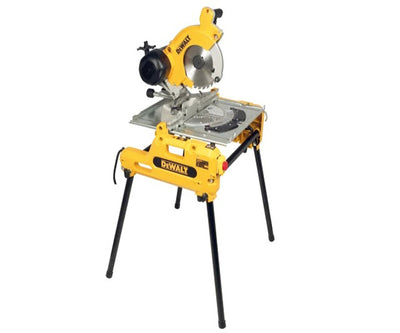
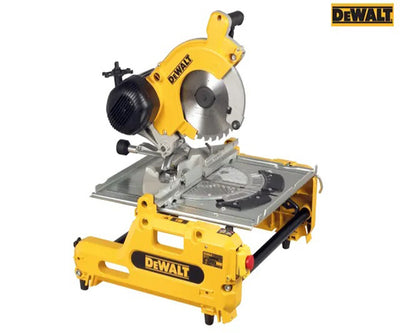
The flip-over saw is a UK/EU-favoured format that combines a table saw and a mitre saw in one machine: the operator flips the tool between the two configurations depending on the cut required. Bench mode (table saw up) for ripping and long straight cuts; mitre mode (flipped over) for cross-cutting and angled cuts. The advantage is one machine and one footprint doing two jobs; the tradeoff is neither function is quite as good as a dedicated table saw or a dedicated mitre saw.
- DEWALT DW743N Flip-Over Saw (250mm blade, 2000W, 240V): the DEWALT flip-over that has been the reference in this format for years. 250mm blade capacity, 2000W motor, robust cast construction for regular workshop use. Right for the joinery workshop that needs both table saw and mitre saw functions but does not have the floor space (or the budget) for two dedicated machines.
Radial arm saws: industrial cross-cutting
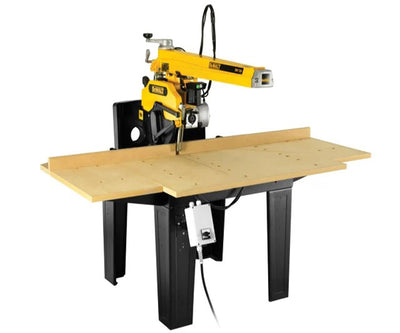
The radial arm saw is the classic industrial cross-cutting machine: motor on an overhead arm that slides toward the operator through the workpiece, with the timber held stationary against the fence. Radial arm saws have largely been replaced by sliding mitre saws in modern UK workshops, but for high-volume production cross-cutting of long timber lengths and heavy cross-sections, the radial arm still has advantages: deeper cut capacity, more powerful motors, better dust collection integration, and no compromise on cutting accuracy across a long fence.
- DEWALT DW729KN Radial 3 Phase Arm Saw (350mm blade, 4000W, 400V 3-phase): the industrial specification radial arm saw. 350mm blade capacity for heavy sections, 4000W 3-phase motor for continuous production use, and the DEWALT build quality that has kept these machines running in UK joinery shops for decades. Requires industrial 3-phase electrical installation (not domestic single-phase supply). The specification for established joinery workshops with volume production requirements.
Scroll saws: precision curve cutting
A scroll saw is a specialist tool for cutting intricate curves, internal cut-outs and detail work in thin material (typically up to 50mm in softwood, less in hardwood and metal). The blade oscillates up and down through a small throat opening while the workpiece is fed by hand around the curved cut line. Used for model making, marquetry, decorative joinery, craft workshops, sign work and cabinet joinery detail:
- Einhell TC-SS 406 E Scroll Saw (120W, 240V): the entry-to-mid specification scroll saw for craft workshops, hobby joinery, model engineering and light detail work. 120W is the correct motor sizing for scroll saw work (higher power is not always better - controlled slow cutting is what scroll saws are for).
110V vs 240V vs 3-phase: choosing the right electrical specification
- 110V (yellow site transformer): mandatory for UK construction sites under CDM 2015 and Electricity at Work Regulations 1989. If the saw is going on a commercial construction site, it must be 110V. The Makita 2712/2 110V is the site specification in this collection.
- 240V single-phase mains: the standard for workshop, refurbishment, domestic install and any environment where the tool will stay in one place with normal mains power. Most site saws and workshop saws in this collection are 240V.
- 400V 3-phase industrial: the specification for established joinery workshops with permanent industrial electrical installation. Higher motor power, smoother torque delivery, better for continuous production. The DEWALT DW729KN Radial Arm is 3-phase. Requires a workshop with 3-phase power supply and a competent installer for connection.
Site saw vs table saw vs mitre saw vs radial arm
These formats overlap in some cuts but each has strengths:
- Site saw: portable table saw with folding stand. Ripping, cross-cutting sheet goods, general trade timber work. Right for site work and workshops that need to move the machine.
- Table saw (fixed): permanent workshop installation, larger table, more accurate for repeat production. See our table saws collection.
- Mitre saw (chop saw): dedicated cross-cutting and angled cuts. Faster and more accurate than a site saw for repetitive cross-cuts. See our mitre saws collection.
- Radial arm saw: high-volume cross-cutting of long/heavy timber. Industrial workshop specification, largely replaced by sliding mitre saws in modern setups.
- Flip-over saw: combines site saw and mitre saw functions in one machine. Compromise solution when floor space or budget rules out two dedicated tools.
Safety and standards
Site and workshop saws are among the highest-hazard power tools in trade use:
- PUWER 1998 (Provision and Use of Work Equipment Regulations) applies: machines must be maintained, inspected, and operated by trained users only.
- Riving knife and crown guard in place: these safety devices prevent kickback and blade contact and must never be removed. Kickback (workpiece thrown back at the operator by the blade) is the most common serious injury on table saws.
- Push stick for narrow rip cuts: fingers must never come within 300mm of the blade when ripping narrow stock. A push stick keeps the hand at safe distance.
- Correct blade for material: use appropriate circular saw blades matched to the material (TCT for wood, specific specifications for laminate, metal or masonry).
- Dust extraction: workshop wood dust is a Category 1 carcinogen (IARC). Connect the saw to a workshop dust extractor (M-class minimum) for indoor use. See our vacuums and dust extraction range.
- PPE: safety glasses, respiratory protection (FFP3 for continuous work), safety gloves for handling stock (never gloves at the blade - loose material can be drawn in), and hearing protection for extended use.
- 110V requirement on construction sites per CDM 2015 and the Electricity at Work Regulations 1989.
- PAT testing for portable equipment in commercial use; annual electrical safety inspection for fixed workshop installations.
Choosing the right site or workshop saw
- UK construction site with 110V transformer: Makita 2712/2 315mm Site Saw 110V.
- Workshop or refurbishment with 240V mains: Makita 2712/2 315mm 240V or Metabo TKHS 315 M 240V.
- Workshop needing both table saw and mitre saw in one machine: DEWALT DW743N Flip-Over Saw.
- Established joinery workshop with 3-phase power and volume production: DEWALT DW729KN Radial 3 Phase Arm Saw.
- Craft workshop, model engineering, decorative cutting: Einhell TC-SS 406 E Scroll Saw.
- Volume trade production, alternative to radial arm: see our mitre saws range (sliding compound mitre saws have largely replaced radial arm saws in modern workshops).
Related categories
The Site and Workshop Saws collection sits under our wider power tools category and alongside our other powered saws: table saws, mitre saws, circular and trim saws, plunge saws, reciprocating saws, chop and cut-off saws and bandsaws. For blades to feed the saws, see our circular saw blades, jigsaw blades and wider Bits, Blades & Accessories range. For dust extraction, browse our vacuums and dust extraction. For workshop machines beyond saws, see our workshop machines collection.
For trade orders, joinery workshop kitting, site carpentry contract supply or specific DEWALT, Makita, Metabo or Einhell references, request a quote and our team will get back to you with availability.