

Drywall Cutters
Drywall cutters (also called drywall cut-out tools or plasterboard routers) are the specialist cordless power tool for cutting clean, precise openings in plasterboard - the tool that turns cutting socket boxes, downlight holes, extractor fan cut-outs and access panels from a slow score-and-snap job into a five-second cut. This is the collection for drylining contractors, first-fix electricians, second-fix installers, plasterboard fitters, kitchen fitters and bathroom installers who work with Gyproc, British Gypsum, Knauf and other plasterboard systems every day.
Key features across the range: high-speed rotary cutting that fresas through plasterboard without vibrating the sheet, depth-adjustable spiral bits that cut the surface layer only when needed, compact one-handed operation for overhead ceiling work, 18V cordless platform for site work without trailing leads, and brushless motor options (DEWALT XR) for longer battery life and reduced maintenance. All units in this collection are supplied as bare tools, compatible with your existing 18V battery platform (Makita LXT or DEWALT XR).
The brands here are the two trade references for cordless drywall cutting: Makita (with the DSD180Z and DCO180Z on the 18V LXT platform) and DEWALT (with the DCE555N brushless cut-out tool on the 18V XR platform).

3 products
Drywall Cutters – Product list

Drywall cutters and cut-out tools at MTN Shop UK
A drywall cutter is one of those specialist tools that transforms a specific job from tedious to trivial. Cutting socket box openings, downlight holes and extractor fan cut-outs in plasterboard with a utility knife and hand saw is possible, but it is slow, dusty, prone to chipping the paper face and ends up needing filler around the finished edge. A dedicated drywall cutter with a spiral cutting bit runs at high speed, produces a clean square edge, works from either face of the board, and lets a first-fix electrician cut out twenty socket boxes on a first-fix run in the time it used to take to do five. On any job with plasterboard, the drywall cutter pays back the tool cost within a couple of days.
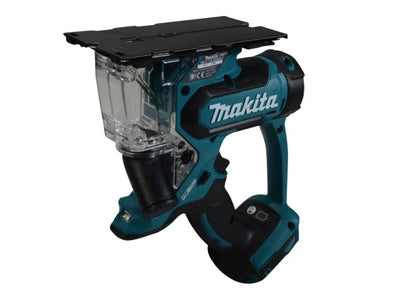
Makita DSD180Z and DCO180Z (18V LXT)
The Makita cordless drywall cutter range runs on the Makita 18V LXT platform, the most widely-adopted cordless system in UK trade:
- Makita DSD180Z LXT Drywall Cutter 18V: the compact drywall cutter with variable speed control, depth-adjustable cutting bit, and the one-handed operation profile that makes overhead ceiling work manageable without wrist fatigue. Bare unit for existing Makita 18V users.
- Makita DCO180Z Drywall Cutter 18V: the cut-out tool variant with adjustable depth stop and the specification for repeat identical cut-outs on production first-fix work. Bare unit for existing Makita 18V users.
Both models use the Makita 18V LXT battery platform, so any Makita 18V battery from the existing kit will run them. If you are on the Makita LXT platform for other tools (drill, impact driver, circular saw), the drywall cutter slots straight in without new batteries.
DEWALT DCE555N XR Brushless (18V XR)
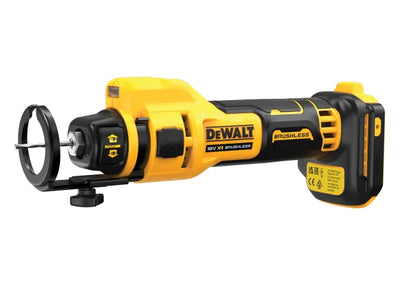
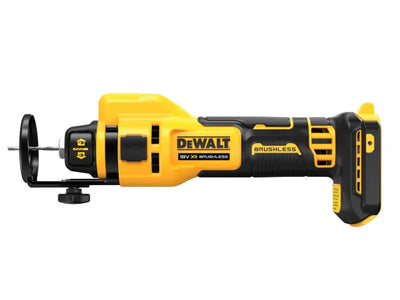
The DEWALT DCE555N XR Brushless Drywall Cut Out Tool is the DEWALT platform answer, on the 18V XR system:
- Brushless motor: longer runtime per battery charge, longer motor service life, less internal wear compared to brushed motors. Standard specification on modern DEWALT XR trade tools.
- Depth-adjustable spiral bit: cuts to the exact depth needed, no risk of over-cutting into pipes or cables behind the plasterboard.
- Compact profile: designed for one-handed operation in confined spaces, above head height, and behind studs where a bigger tool cannot reach.
Bare unit for existing DEWALT 18V XR users. The XR platform is DEWALT's professional cordless system, compatible with the wider range of DEWALT XR drills, drivers, saws and site tools.
Common drywall cutting applications
- Socket box cut-outs (first-fix electrical): standard 25mm-deep and 47mm-deep single and double socket box openings, cut to the exact box dimensions from a template or from the back of the box marked through the board.
- Downlight cut-outs: circular openings for 65mm, 75mm and 92mm ceiling downlights, cut cleanly without cracking the plasterboard around the hole.
- Extractor fan and ducting cut-outs: 100mm to 150mm openings for bathroom and kitchen extractor installation.
- Ceiling rose and pendant fitting openings: smaller circular cuts for ceiling roses, junction boxes and pendant light installations.
- Access panel cut-outs: square openings for plumbing access, boiler service panels and MVHR unit access.
- Cornice and coving penetrations: shaped cuts through decorative plasterboard mouldings for services and fixings.
Drywall cutter vs jigsaw vs multi-tool
All three tools can cut plasterboard, but each has strengths and weaknesses:
- Dedicated drywall cutter: fastest, cleanest edge, controlled depth, best for volume work and repeat cut-outs. The trade specification for anyone cutting plasterboard regularly.
- Jigsaw: versatile for other materials but slower on plasterboard, harder to control depth, generates more dust, and the plasterboard edge tends to chip on the up-stroke unless a down-cut blade is used. Right for the occasional cut but not for a first-fix run.
- Oscillating multi-tool: excellent for detail work and cutting close to existing fittings, but slow for larger openings and requires patience for accuracy. Complementary to a drywall cutter, not a replacement.
- Utility knife + score & snap: the traditional plasterboard cutting method for full-sheet cuts along a straight line. Still the right choice for cutting sheets to size on the bench, but useless for internal cut-outs.
Cutting bits
Drywall cutters use spiral cutting bits (drywall router bits) that are specific to plasterboard: sharp helical flutes that pull the dust away from the cut, high-speed rotation to fresas through the gypsum core, and a small pilot tip that allows plunge-cutting into the middle of a board without a pilot hole. Bits are sold separately as consumables and wear over time; keep spares in the tool case, especially on first-fix runs where a broken bit halfway through the day means a trip back to the van or the merchant.
Safety and technique
- Know what is behind the board: the depth-stop must be set correctly to avoid cutting into cables, pipes and services running through the stud cavity. This matters most on second-fix work in existing buildings where the routing of services is not always known.
- Cable and pipe detector: for cut-outs in existing walls, always scan the area with a detector before cutting. Even setting the depth correctly does not help if a cable is bunched against the back of the board.
- Dust protection: plasterboard cutting produces fine gypsum dust that gets everywhere and irritates the airways. Wear an FFP2 dust mask minimum, better with on-tool dust extraction for indoor work in occupied buildings.
- Eye protection: the high-speed rotation throws dust and small board fragments; always wear safety glasses for overhead work particularly.
- Two-handed operation on larger cuts: although the tool is designed for one-handed use, use both hands on longer cut-outs and any work where sudden binding of the bit is possible.
- PAT testing: commercial workshop electrical equipment (including battery chargers) should be tested per the Electricity at Work Regulations 1989.
Choosing the right drywall cutter
- Existing Makita 18V LXT user: Makita DSD180Z or DCO180Z (uses your existing Makita batteries and chargers).
- Existing DEWALT 18V XR user: DEWALT DCE555N (uses your existing DEWALT XR batteries and chargers).
- New to cordless drywall cutting: match the tool to the battery platform you already have in your kit; if you have neither, the DEWALT DCE555N brushless has the longer service life and better running economy for daily trade use.
- Occasional plasterboard work: either brand is adequate; consider the jigsaw or multi-tool alternative if the frequency does not justify a dedicated tool.
Related categories
The Drywall Cutters collection sits under our wider power tools category. For related cutting tools, see our powered saws, reciprocating saws and biscuit jointers and routers. For drilling into stud walls, see our powered drills and drill drivers. For the batteries and chargers to keep the cordless tool running, see our batteries and chargers and accessories ranges. For dust extraction, browse our vacuums and dust extraction range. For PPE while cutting plasterboard, see our dust masks, respiratory protection and safety eyewear ranges.
For trade orders, drylining contractor kits, first-fix electrician resupply or specific Makita LXT or DEWALT XR references, request a quote and our team will get back to you with availability.